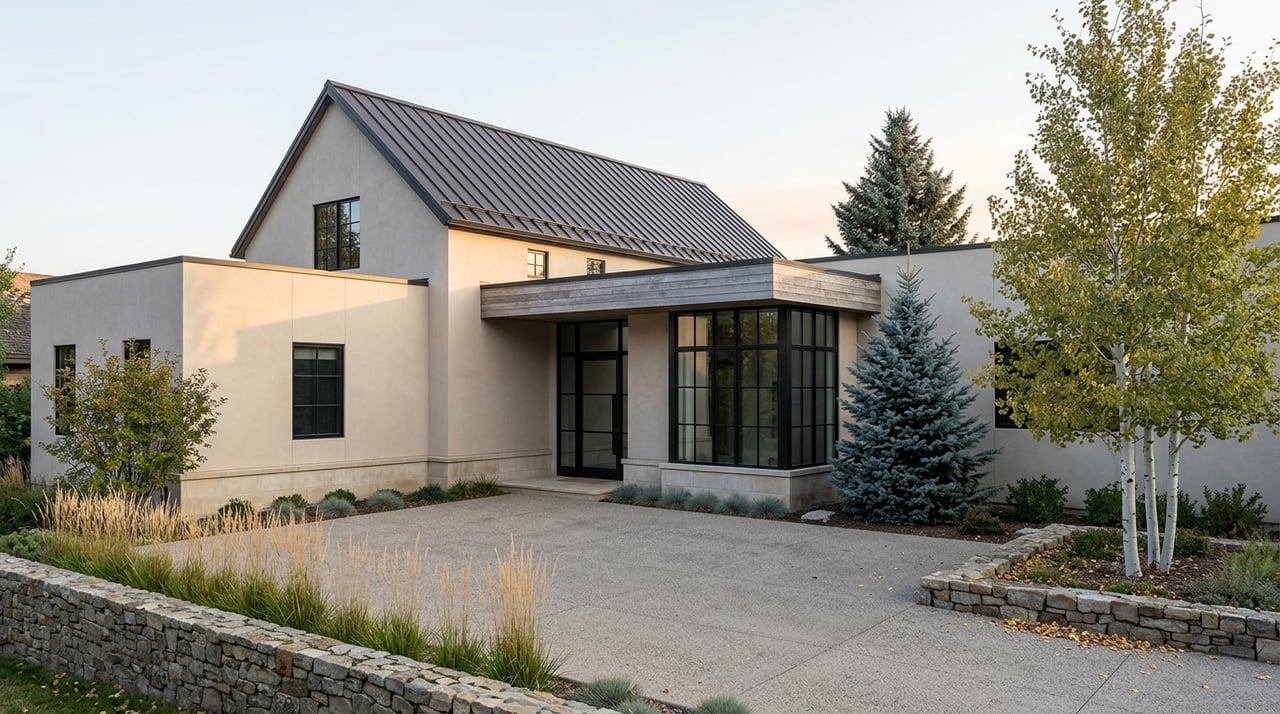
Cottonwood Heights Doesn't Have One Housing Market. It Has Four.
Vir Singh September 3, 2026
Vir Singh September 3, 2026
Drive from the mouth of Big Cottonwood Canyon down through the city in five minutes and you pass a 1970s rambler with a carport, a gated cul-de-sac of twenty-two townhomes with private roads, a custom estate backing up to a golf course, and a homesite listed with an infinity pool and a golf simulator that hasn't been built yet. Same city. Same zip code. Same word, "Cottonwood Heights," on every listing sheet.
None of those four homes has anything to do with the median price you saw on a portal last week. The median describes the average of all of them, which means it describes none of them accurately. That gap between the headline number and the actual house on the actual street is the thing worth understanding before you start comparing Cottonwood Heights to anywhere else.
Pull two live data feeds in the same week of August 2026 and you get two different pictures of the same city. One puts the median list price at $949,000 with an average of $333 per square foot. Another, pulling from the same general market days earlier, shows a median list price of $935,000 but an average of $416.18 per square foot, a meaningfully different number for essentially the same window.
That's not an error in either feed. It's a mix problem. A city where a nine-thousand-square-foot canyon-mouth estate and a small updated condo near Fort Union's shops both count as "Cottonwood Heights" will produce a different average depending on which listings happen to be active on the day you pull the number. Zillow's own home value index, last showing an update as of late June 2026, put the average value at $761,543, up 2.4 percent over the prior year, with homes going to pending in around six days. That's a full market away from either list-price median above. List price, sale price, and automated value index are three different measurements, and in a city this segmented, the gap between them is wider than it would be somewhere more uniform.
Some data providers have started slicing the city into smaller pieces on their own. One tracker breaks out a "North Cottonwood Heights" sub-area separately from the citywide number, and for March 2026 it showed a median sale price of $810,000, up 19.4 percent year over year, with homes taking 64 days to sell compared to 31 days the year before. Fifteen homes sold there that month, up from thirteen the year prior.
That's a smaller, slower, pricier pocket sitting inside the same city that produces a $935,000 to $949,000 median list price a few months later. The fact that a national aggregator felt the need to carve out a sub-neighborhood at all tells you something: even the algorithms have noticed that one number can't carry this city's story.
If you actually walk the subdivisions instead of reading the median, four distinct products emerge.
Four bands, four buyer profiles, and one median trying to average all of them into a single figure that describes none of them.
A .63-acre homesite at the entrance of the canyon, listed to-be-built with an infinity pool, a wellness center, and a golf simulator, has almost nothing in common with the median it's technically part of.
There's a second wrinkle that trips up buyers who assume Cottonwood Heights is one school catchment because it's one city. Most of the city is served by Canyons School District, feeding into Brighton High and Butler Middle. But some western addresses in Cottonwood Heights fall under Granite School District instead, a boundary that doesn't always track cleanly with subdivision names or even street-by-street logic. This isn't a quality question, it's a boundary question, and boundaries shift address by address. Anyone comparing two homes in "the same neighborhood" should confirm the catchment for each specific address rather than assuming the subdivision name settles it.
The practical lesson isn't that Cottonwood Heights numbers are unreliable. It's that a citywide median is a starting point for a phone call, not a pricing tool. If you're comparing this city to a neighbor, the same trap applies elsewhere. Closed sales data for the first quarter of 2026, pulled from the regional MLS, placed Sandy's median near $619,000 for the same window Cottonwood Heights was posting numbers well above it. That gap looks like a simple "Cottonwood Heights costs more" story until you remember Sandy has its own internal spread between its established flats and its foothill lots. The lazy read is city versus city. The accurate read is product versus product, wherever it happens to sit.
For a seller, that means your comp set is your subdivision and your home's specific tier, not the citywide median from a portal. A Hillsborough Estates rambler doesn't compete against a Tavaci to-be-built lot for buyer attention, and pricing it as though it does either scares off the right buyer or leaves money on the table. For a buyer, it means the first useful question isn't "what's the median in Cottonwood Heights" but "which of these four bands am I actually shopping in, and what does that band's inventory and pace of sale actually look like right now."
Is Cottonwood Heights more expensive than Sandy? On a citywide basis, yes, based on Q1 2026 closed sales data. But both cities contain wide internal price spreads by subdivision and product type, so a direct citywide comparison tells you less than comparing similar homes in similar tiers across both cities.
Why do different sites show different median prices for the same month? List price, sale price, and automated value indexes are three different measurements, and in a city with this much product variation, from mid-century ramblers to ultra-luxury new construction, the mix of what's active or recently sold on any given day shifts the average more than it would in a more uniform market.
Does living near the canyon mouth always cost more? Canyon-adjacent gated communities like Tavaci and Old Mill Estates do carry premium pricing tied to proximity and amenities, but an established mid-century home a mile down the hill in a neighborhood like Prospector Hills can still cost less than a townhome closer to the canyon entrance. Location within the city matters as much as location relative to the canyon.
If you're trying to figure out which of these four markets your search or your sale actually belongs in, that's the kind of read that takes local subdivision knowledge, not a portal median. Kingswell Estates works Cottonwood Heights subdivision by subdivision. Let's connect.
Stay up to date on the latest real estate trends.




Get assistance in determining current property value, crafting a competitive offer, writing and negotiating a contract, and much more. Contact Vir today to discuss all your real estate needs!